Key takeaways
- Compressor dehumidifiers with a real built-in pump: compare the Midea 50 Pint, Midea Cube 50 Pint and GE APYR50LC on capacity, pump drainage and noise for basements without a floor drain.
Basements rarely offer the one thing a dehumidifier wants most: a floor drain lower than the machine. Without it, gravity drainage is useless and the bucket fills, the unit stops, and the damp wins until someone carries water upstairs again. A built-in pump changes that equation by pushing condensate up into a sink or out through a window, and that is the dividing line this guide is built on. That single feature separates a machine you install once from a machine you service every day.

It is written for homeowners drying basements, laundry rooms and ground-floor spaces where no suitable drain sits below the unit. Only compressor models were considered, because desiccant and Peltier units play a different, smaller role, and every pick below names a built-in pump on its Amazon listing, with capacity and drainage details drawn from that listing.
Quick Picks
As an Amazon Associate we earn from qualifying purchases.
| Product | Best for | Key spec from title |
|---|---|---|
| Midea 50 Pint with Pump | Classic basement duty with quiet running | 50 pints a day, 47 dBA, built-in pump |
| Midea Cube 50 Pint with Pump | Flexible placement and smart control | Built-in pump, 16 ft drain tube included |
| GE APYR50LC | Long pump runs to a distant sink | Built-in pump drains up to 16 ft away |
How to Choose
Compressor, desiccant or Peltier is the first fork
Compressor dehumidifiers pull moisture by chilling coils, and they dominate the 50-pint class because nothing else moves that much water in warm, damp rooms. Desiccant wheel units work better in cold spaces but cost more to run at this capacity, while Peltier models suit a wardrobe, not a basement. If a listing does not say compressor, check twice. Every model in this guide is a compressor unit sized at 50 pints a day, which is the rating class aimed at large, wet rooms rather than spot drying.
Built-in pump is not the same as a drain hose
Many dehumidifiers advertise continuous drainage and mean a hose that runs downhill by gravity. A built-in pump actively lifts water, so the hose can climb to a sink rim or a high window. Confirm the listing uses the words built-in pump, and look for the lift or distance figure the maker states. Also check what arrives in the box: one pick here includes a 16-foot drain tube, while others expect you to supply a hose. Confusing a pump-ready port with an actual fitted pump is the most expensive reading mistake in this category.
Read the pint rating and coverage together
The 50-pint figure is measured under standard test conditions and describes a day of heavy moisture removal, not a promise for every room. Coverage claims, such as 4,500 square feet, assume open space and moderate damp. A basement split into small rooms, or one with water actively entering, will behave like a much harder job than the square footage suggests. Use the pint rating to compare machines against each other, then be conservative: a chronically wet basement deserves the full 50-pint class even at modest size, while a merely humid one can run it at lower fan speeds.
Plan for noise, power and the humidity range
A compressor and fan running beside a living space will be heard. The quietest listing here quotes 47 dBA, roughly appliance-hum territory, and fan speed changes that number a lot. Check the wattage too, since a unit drawing around 520 W that runs most of the day is a real line on the power bill. Finally, look at the adjustable humidity range: the Midea spans 35 to 85 percent relative humidity, which covers both aggressive drying and gentle maintenance without short-cycling the compressor.
The 3 Best Options
Midea 50 Pint with Pump
This is the straightforward basement answer. The listing rates it at 50 pints a day for spaces up to 4,500 square feet, with a built-in pump that can drain vertically or horizontally, which covers both the utility-sink climb and the sideways run to a distant drain. Noise is quoted at 47 dBA, low for this class, and the bucket holds 1.6 gallons as a fallback for days when the pump hose is disconnected. The humidity range runs from 35 to 85 percent, so the same machine can dry a flooded corner hard and then hold a finished basement gently.
Specs
- Model: MAD50P1AWS
- Capacity: 50 pints per day
- Coverage: Up to 4,500 sq ft
- Drainage: Built-in pump, vertical or horizontal drain
- Bucket: 1.6 gallons
- Noise: 47 dBA
- Humidity range: 35 to 85 percent relative humidity
Best for: Unfinished basements where the only drain is a utility sink above floor level.
Watch out for: Confirm your hose route before ordering; the pump lifts water, but kinks and long runs still slow drainage.
ASIN: B0866XLRTX
Midea Cube 50 Pint with Pump
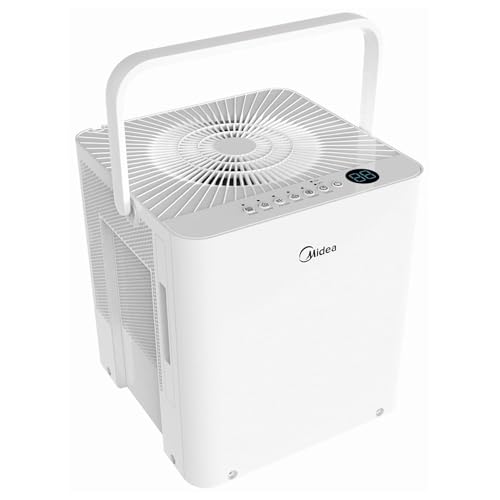
The Cube rearranges the same 50-pint job into a stackable, lift-off design, and its listing includes the detail that matters here: a built-in pump with a 16-foot drain tube in the box. That tube length opens placements that shorter included hoses cannot reach, such as a laundry room where the standpipe sits across the room. Smart control with Alexa support means the humidity target can be changed from upstairs, which suits finished basements used as living space. Buyers who value placement freedom and out-of-box completeness over the classic tower shape should start with this one.
Specs
- Model: MAD50PS1QWT
- Capacity: 50 pints per day
- Drainage: Built-in pump
- Included: 16 ft drain tube
- Controls: Smart control, Alexa compatible
Best for: Finished basements and laundry rooms where the drain point is across the room.
Watch out for: The cube format stores water differently from a front bucket; check the lift-off tank routine suits you before buying.
ASIN: B091BYVD2W
GE APYR50LC
GE’s entry leans on reach. The listing states a built-in pump with hose that drains up to 16 feet away, which is the figure to compare if your sink sits on the far wall. Capacity matches the class at 50 pints a day, the draw is 520 W, and the listing carries Energy Star, relevant for a machine that may run daily for months. The collection tank is smaller than the Midea tower’s bucket, but with the pump plumbed in, tank size becomes a backup specification rather than a daily concern. It suits buyers who trust an appliance brand’s service network.
Specs
- Model: APYR50LC
- Capacity: 50 pints per day
- Drainage: Built-in pump with hose, drains up to 16 ft away
- Power: 520 W
- Energy Star: Listed
Best for: Basements where the sink or drain is on the opposite wall from the damp corner.
Watch out for: Smaller collection tank than the Midea tower, so bucket-only use between pump hookups fills faster.
ASIN: B0C6L8FDRC
Which One Fits Your Situation
A damp unfinished basement with a utility sink
The standard Midea 50 Pint is the match. Its pump drains vertically into a raised sink, the 47 dBA rating keeps the noise tolerable under living space, and the larger bucket covers weekends when the hose is off. Set the target near the middle of its range and let it work.
A finished basement used as a living room
Choose the Midea Cube. Smart control from upstairs, a long included drain tube and a shape that looks less like site equipment all fit a room people sit in. Run the tube once, neatly, and the machine disappears into the background of the room. Humidity you can set from the sofa is humidity you will actually bother to maintain.
The drain is far from the wettest corner
The GE APYR50LC earns its place here, because its listing quantifies the pump reach at up to 16 feet. Measure your actual route, including the climb, before assuming any pump covers it; if the run fits inside that figure with room to spare, this is the safest of the three picks.
You only have a floor drain after all
Any of the three will gravity-drain through a hose, but the pump premium buys you nothing in that layout. Of this shortlist, take the standard Midea for its bigger bucket and quiet rating, and keep the pump as insurance for the day you move the machine. Just confirm the hose connection is tight before walking away from the first run.
Common Mistakes
- Buying a unit with a drain hose port and assuming a pump is inside; gravity drainage cannot climb to a sink.
- Choosing a desiccant or Peltier unit for a wet basement because the listing hid the technology type.
- Sizing by square footage alone while ignoring how wet the space actually is.
- Running the pump hose with kinks, sags or an uphill-then-downhill route that traps water, and then blaming the pump for slow drainage.
- Setting the humidity target extremely low, which runs the compressor constantly without making the room feel better.
Frequently Asked Questions
How high can a built-in pump lift water?
Listings express this as lift or as total drain distance, and the GE here quotes up to 16 feet of drainage reach. The vertical climb to a sink rim is usually only a few feet; the rest is horizontal run. Measure your full route, keep it as straight as possible, and stay inside the stated figure with margin. Shorter, straighter routes also help the pump work less hard.
Does a pump model still need the bucket emptied?
Not in normal operation. The pump moves water out continuously, so the bucket acts as a reservoir the pump draws from rather than a tank you carry. You will still want the bucket accessible for cleaning, and if the pump or hose is disconnected, the unit reverts to bucket filling and will stop when full.
Will a 50-pint compressor unit work in a cold basement?
Compressor efficiency falls as air temperature drops, and coils can frost in genuinely cold spaces, which is why low-temperature operation is a stated feature on some listings. For a heated or moderately cool basement, a 50-pint compressor model is the right tool. For an unheated space that sits near freezing, a desiccant unit is the better technology despite the running cost.
How dry should a basement be kept?
Most guidance for stored goods and finished rooms lands between 30 and 50 percent relative humidity. Below that range you waste energy and can over-dry wood; above it, mould risk climbs. The adjustable range on these models covers both ends, so set the target, verify with a separate hygrometer across a week, and adjust once.