Our Short List of 3
All 4 Picks at a Glance
| Product | Specs | Action |
|---|---|---|
 1. Southwest Archery Spyder: Best Overall Adult Starter | Check price on Amazon | |
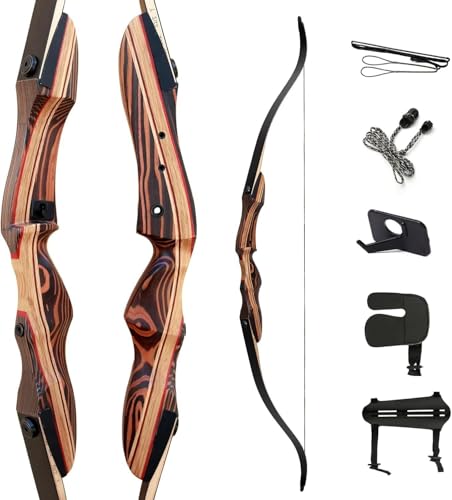 2. Deerseeker 62 Takedown Recurve Set: Best Complete Starter Set | Check price on Amazon | |
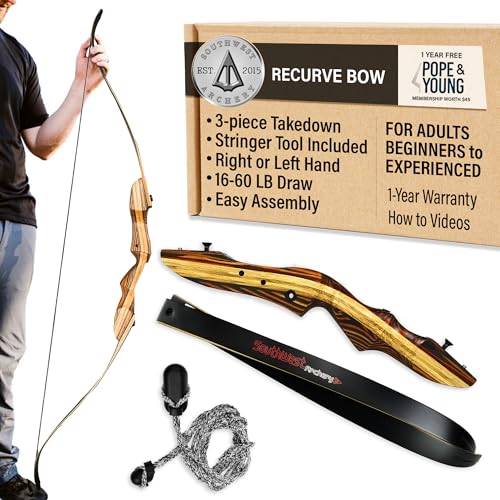 3. Southwest Archery Tigershark Pro V2: Best Step-Up Build | Check price on Amazon | |
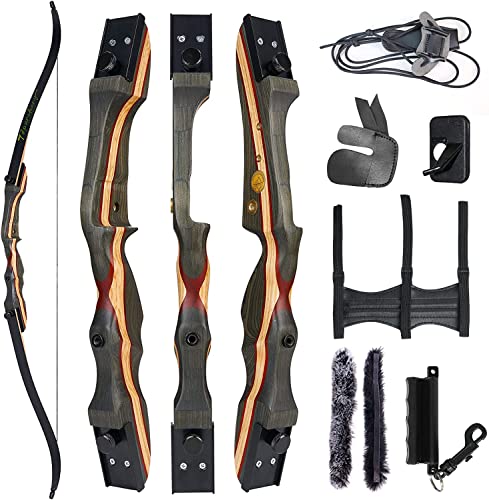 4. TOPARCHERY 62 Wooden Takedown Recurve: Best Budget Kit | Check price on Amazon |
Key takeaways
- The best beginner recurve bow for adults is a 62 to 66 inch takedown recurve starting at 25 to 35 lb. Compare five adult starter bows and learn how to choose draw weight.
As an Amazon Associate we earn from qualifying purchases.
Affiliate Disclosure: This article contains affiliate links. If you buy through a link on this page, we may earn a commission at no extra cost to you.
The most common mistake an adult makes when buying a first recurve bow is not choosing the wrong brand. It is choosing a bow that is too short or too heavy to learn on. Youth bows and short 54 or 58 inch recurves stack, pinch the fingers and punish sloppy form, and a 45 or 50 pound draw weight that looks sensible on a product page will wreck a new archer’s shoulder and teach flinching instead of technique. The best beginner recurve bow for adults solves both problems at once: a full-size takedown recurve of 62 to 66 inches, which draws smoothly to an adult draw length, fitted with limbs of 25 to 35 pounds, which is heavy enough to shoot flat at club distances and light enough to hold at full draw while you learn what a clean release feels like.
Takedown design matters for a beginner because the limbs unbolt from the riser. Start on light limbs, and when your form and strength improve, you buy heavier limbs for the same riser instead of a whole new bow. Every pick in this guide is an adult-size takedown recurve in that pattern, from makers whose listings we could verify on Amazon US. Four picks carry purchase links. The fifth, the most famous beginner recurve of all, is analysed without a link, and we explain exactly why below. All specifications come from manufacturer and product listing information rather than from our own shooting, and the fitting advice follows standard archery coaching practice.
Quick Comparison
| Pick | Length | Starting Weights to Choose | System | Best For |
|---|---|---|---|---|
| Southwest Archery Spyder | 62 in, 64 in XL | 25 to 35 lb from a 20 to 60 lb range | Bolt-on limbs | Best overall adult starter |
| Deerseeker 62 Takedown Set | 62 in | 25 to 35 lb from a 20 to 60 lb range | Bolt-on limbs | Best complete starter set |
| Southwest Archery Tigershark Pro V2 | 62 in | 25 to 35 lb from a 25 to 60 lb range | Pin-locking limbs | Best step-up build quality |
| TOPARCHERY 62 Wooden Takedown | 62 in | 25 to 35 lb from a 20 to 50 lb range | Bolt-on limbs, kit included | Best budget kit |
| Samick Sage | 62 in | 25 to 35 lb from a 25 to 60 lb range | Bolt-on limbs | The classic, analysed without a link |
How to Choose Your First Adult Recurve
Draw weight: start at 25 to 35 pounds, honestly
Draw weight is measured at a standard 28 inch draw. For a first bow, most adult men should start at 30 to 35 pounds and most adult women at 25 to 30 pounds, and anyone who has not drawn a bow before should treat the lower end of that guidance as the smart end. A useful test from coaching: if you cannot hold the bow at full draw, steady, for ten slow seconds while keeping your bow shoulder down, the bow is too heavy for learning, whatever the number says. Form learned on light limbs transfers to heavier limbs later. Form learned while wrestling an over-heavy bow becomes a set of habits you will pay a coach to undo. The takedown system exists precisely for this progression, so buy the light limbs now and the heavier set next season.
Remember also that recurve draw weight climbs as you draw further. A bow rated 30 pounds at 28 inches will feel closer to 33 or 34 pounds at a 30 inch draw, which is another reason taller, longer-armed beginners should not start at the top of the range.
Bow length: match it to your draw length
For adults, 62 inches is the practical minimum and the standard size for the bows in this guide. As a rule of thumb, a 62 inch bow suits draw lengths up to about 28 or 29 inches. If your draw length is 29 to 31 inches, look for a 64 or 66 inch bow, such as the Spyder XL below, so the limbs do not stack, which is the sharp rise in weight near full draw that makes long-draw archers miserable on short bows. Measure your draw length before ordering: stand relaxed, stretch both arms out to the sides, and measure fingertip to fingertip, then divide by 2.5. That gives a close estimate for most adults. If the result is over 29 inches, buy the longer bow.
Handedness is about your eye, not your hand
A right-handed bow is held in the left hand and drawn with the right, and you should choose by eye dominance rather than writing hand. Many right-handed people are left-eye dominant and shoot far better with a left-handed bow. Most picks here are sold in both orientations, so check your dominant eye with a simple point-and-close test before you order, and select the version that matches it.
What else you need
A bow alone is not a shooting kit. Budget for arrows matched to your draw weight and length, an arm guard, a finger tab or glove, and a bow stringer, which you should use every time you string or unstring a recurve to protect the limbs from twisting. Some sets below include several of these items; where a set includes arrows, check their spine and length against your draw before shooting them. Never dry-fire a recurve, meaning drawing and releasing without an arrow, because the energy that should go into the arrow goes into the limbs instead.
The Picks in Detail
1. Southwest Archery Spyder: Best Overall Adult Starter
The Spyder was designed by the engineers behind the original Samick Sage, and it follows the same proven formula with a few refinements. It is a 62 inch takedown recurve with a riser built from several hardwoods including dymondwood, white oak, padouk and hard maple, and limbs of hard maple laminated with black fiberglass. Draw weights run from 20 to 60 pounds in 5 pound steps, so an adult beginner should order the 25, 30 or 35 pound limbs and keep the riser for years of progression.
Two details lift it above generic copies. The limb bolts sit flush rather than standing proud, which keeps the lines clean and the hardware out of the way, and the riser comes with threaded bushings already installed for a sight, stabiliser, plunger and quiver, so the bow can grow from bare starter to a fitted target setup. Reinforced limb tips allow Fast Flight and Flemish strings as an upgrade. For taller adults, the Spyder XL stretches the same design to 64 inches, the version to choose with a draw length around 30 inches or more. The package includes the riser, limbs, a 14-strand Dacron string, an adhesive arrow rest and instructions, and some listings bundle a stringer tool; confirm the stringer is in the box or buy one separately, because you will need it from day one.
2. Deerseeker 62 Takedown Recurve Set: Best Complete Starter Set
The Deerseeker 62 is a Sage-pattern takedown recurve sold as a fuller starter package, which is its main appeal for an adult who owns nothing yet. The bow itself is 62 inches, with a riser of hard maple and dymondwood laminate and limbs of fiberglass over maple, offered from 20 to 60 pounds in 5 pound increments; again, 25 to 35 pounds is the sensible starting band. Published figures list a brace height around 7.5 to 7.9 inches, a bow weight of about 2.16 pounds, and a maximum comfortable draw around 30 inches on the 62 inch model, which makes it one of the friendlier options here for longer-armed beginners.
The set typically adds a bow string, stringer tool, finger tab, arm guard, arrow rest and an Allen key to the box, covering most of the accessory list in the fitting section above in a single purchase. Threaded bushings allow a sight, stabiliser or quiver later. The honest caveats are that included accessories in budget sets are serviceable rather than premium, and you will likely upgrade the tab and arrows first, and that limb fit and finish vary more at this price than on the Southwest Archery bows. As a one-box route from nothing to shooting, though, it is hard to argue with, and the underlying bow dimensions are exactly right for an adult learner.
3. Southwest Archery Tigershark Pro V2: Best Step-Up Build
The Tigershark Pro V2 is Southwest Archery’s more refined 62 inch takedown, for the beginner who already knows archery will stick and would rather buy the nicer riser once. It is built from layered naturally sourced woods, comes in right and left hand from 25 to 60 pounds, and adds the company’s precision pin-locking limb system, which locates the limbs in exactly the same position every time you assemble the bow. Consistent limb placement means your brace height and tune stay put between sessions, a small thing that removes a whole category of beginner frustration.
The Pro limbs expose maple on the limb sides, have reinforced tips that are Fast Flight and Flemish string compatible, and the riser carries the usual pre-installed bushings for accessories. The package includes the riser, matching limbs, a 14-strand Dacron string, a shelf-pad style arrow rest, instructions, and on the Pro V2 listings a stringer tool. Southwest Archery covers its bows with a one-year manufacturer warranty when registered. Start, as with every bow here, at 25 to 35 pounds despite the hunting weights on the same listing; the Pro’s advantage is build quality and repeatability, not permission to start heavy.
4. TOPARCHERY 62 Wooden Takedown Recurve: Best Budget Kit
TOPARCHERY’s 62 inch wooden takedown is the value route into the same adult dimensions. The listing describes a wood riser with fiberglass and wood limbs, right-handed, in draw weights from 20 to 50 pounds, and a generous kit in the box: riser, two limbs, string, stringer, a rest pad, finger saver, arm guard, string nocks, string silencers and an arrow puller. For a complete beginner, having the stringer and protection included at this price removes the two most common reasons people delay or improvise unsafely.
Choose the 25, 30 or 35 pound version, and note the limits honestly. This version is listed right-handed only, so left-eye-dominant archers should pick one of the ambidextrous options above instead. Kit accessories are basic, the finish is plainer than the Southwest Archery risers, and quality control on budget limbs means you should inspect the limbs for straightness when the bow arrives and check the limb bolts after your first few sessions. None of that prevents it from teaching you to shoot: the geometry is the standard 62 inch learning geometry, and that matters more than cosmetics.
5. Samick Sage: The Classic, Analysed Without a Link
The Samick Sage is the bow that defined this entire category: a 62 inch takedown recurve with a hard maple riser, maple-core limbs laminated in fiberglass, draw weights from 25 to 60 pounds, brass bushings for accessories, and a recommended brace height around 7.5 to 8.25 inches. Its limbs also fit the Spyder above, which tells you how completely the Sage pattern became the standard. On specification and reputation it would be the first name on this list, and for a beginner who finds one in stock at a reputable archery dealer, it remains an excellent choice at 25 to 35 pounds.
We have deliberately not linked it here. When we checked its long-standing Amazon US listing for this guide, the listing showed no featured offers available, which means we could not verify a clean, buyable Amazon offer for it at the time of writing. Linking you to a dead or marketplace-only listing would not help you, so the Sage appears as analysis only. If its Amazon availability returns, it belongs at the top of this comparison; until then, the Spyder, built by the Sage’s own designers, is the closest verified alternative.
Your First Month With the Bow
Spend the first sessions close to the target, at ten yards or less, shooting at a large face with no scoring at all. Your only job is a repeatable sequence: stance, nock, set your bow hand, raise, draw to the same anchor point, aim, release without grabbing at the string, and let the bow hand stay up until the arrow lands. String the bow with the stringer, check brace height with a ruler against the maker’s range, and unstring the bow for storage if the maker recommends it, which keeps the limbs honest for years. When you can hold a steady ten-second full draw on your starting limbs and your groups at fifteen yards fit on a paper plate, that, not the calendar, is your signal to order the next limb weight up, in a 5 pound step.
Frequently Asked Questions
What draw weight should an adult beginner really start with? For most adults, 25 to 35 pounds: typically 30 to 35 for men and 25 to 30 for women as a starting estimate, adjusted by the ten-second hold test described above. Starting light is not a compromise; it is how proper form is built, and takedown limbs make moving up cheap.
Is a 62 inch bow long enough for a tall adult? It depends on draw length more than height. Up to about a 28 or 29 inch draw, a 62 inch bow is comfortable. Beyond that, choose a 64 or 66 inch bow, such as the Spyder XL, to avoid stacking and finger pinch at full draw.
Can I hunt with a beginner recurve later? The same riser with heavier limbs, typically 40 pounds and up where regulations require it, is a legitimate hunting setup, and several bows here are offered to 60 pounds. Learn on light limbs first, move up gradually, and check your local rules for minimum draw weight before hunting.
Right or left handed: which do I order? The one that matches your dominant eye. A right-handed bow is held in the left hand. Test eye dominance first; shooting with the dominant eye in charge matters more than which hand writes.
Verdict
An adult beginner needs length, light limbs and a riser worth keeping, in that order. The Southwest Archery Spyder delivers all three with the cleanest verified listing we found, the Deerseeker set adds the accessories a new archer owns none of, the Tigershark Pro V2 buys better fit and repeatability for the committed learner, and the TOPARCHERY kit does the job for the least money. The Samick Sage remains the category’s benchmark on paper, and we have told you plainly why it carries no link here. Buy the length that fits your draw, start at 25 to 35 pounds, use the stringer every time, and let your form, not your ego, decide when the heavier limbs go on.